5S Method: The Impact of Japanese Work Organization Philosophy on Global Industry
The scale of time losses from searching for tools, documents, or materials in a production environment is significant. Multiplying these delays by the number of employees and workdays yields measurable operational costs, underscoring the need for systematic optimization solutions.
In the 1960s, leaders of Japanese industry, as part of the Toyota Production System (TPS), developed the 5S system. Its goal wasn’t workspace aesthetics, but achieving competitive advantage through eliminating waste and boosting process efficiency
From Post-War Reconstruction to International Dominance
The origins of the 5S system trace back to post-World War II Japan, when the country was struggling with limited resources and competitive pressure from American corporations. Companies, especially Toyota, sought ways to maximize efficiency with minimal input.
At that time, the 5S philosophy emerged – based on five Japanese words beginning with the letter “S.” It represented a practical response to real challenges: workshop disarray, time wastage, low productivity, and workplace accidents.
Toyota integrated 5S into its Toyota Production System (TPS), enabling the method’s further global expansion. Today, 5S forms the foundation of Lean Manufacturing philosophy, applied in millions of enterprises worldwide – from small workshops to major aerospace corporations. Its effectiveness stems from simplicity, visual nature, and immediate results.
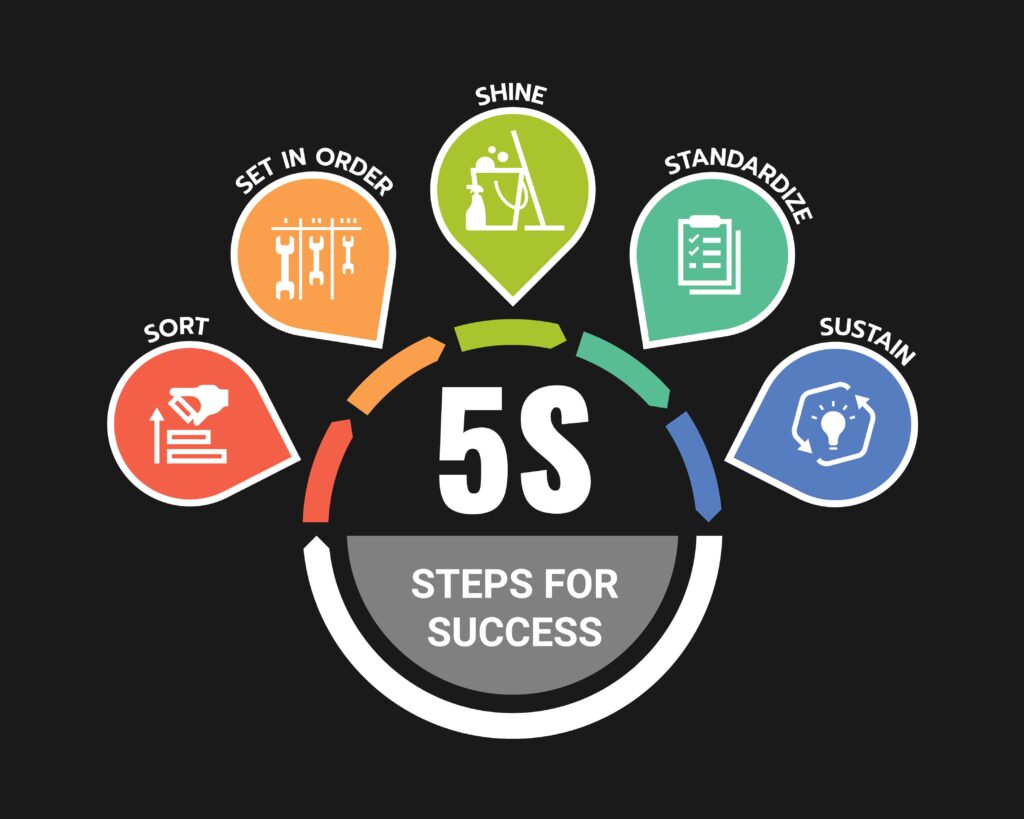
Five Steps to Workplace Transformation
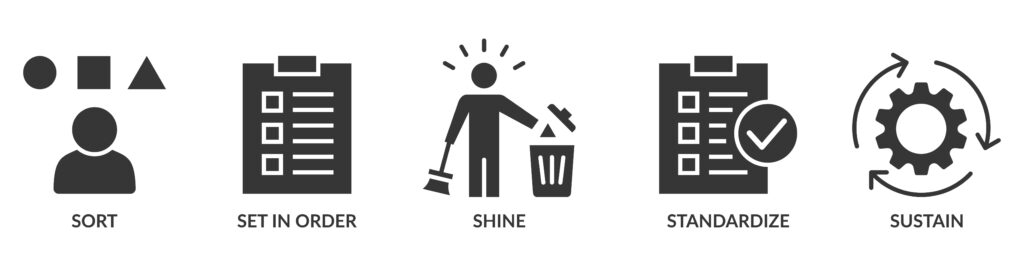
1S: Seiri (Sort) – Separate the Necessary from the Unnecessary
The first principle, akin to a comprehensive resource audit, requires evaluating every item based on its current utility: “Is it essential here and now?”
In practice, the Red Tag Strategy technique is applied: the team tags items unused in the recent period, duplicated, damaged, or unsuitable for the location. Each label includes the name, date, and justification. Tagged items go to a quarantine zone for 30 days—lack of demand results in disposal, sale, or relocation.
As a result, machine operators have access only to essential tools, increasing available workspace and reducing errors. The goal: elimination of non-value-adding elements, minimization of chaos and mistakes.
2S: Seiton (Set in Order) – A Place for Everything, Everything in Its Place
Following selection, it is essential to assign a fixed location to each item according to the principle: “Every item has a designated location from which it is retrieved and to which it returns.”
Implementation Techniques in This Phase Include:
- Visual management: tool outlines and shadows on boards, color coding, photographic labels.
- Organization by frequency of use: Zone A (within arm’s reach for items used hourly), Zone B (within workstation for daily items), Zone C (e.g., nearby cabinet for occasional items).
- FIFO principle (First In, First Out) for production materials.
- Warehouse location coding (each shelf has a unique code, e.g., A-3-12 = aisle A, rack 3, shelf 12) managed by computer system.
3S: Seiso (Shine) – Cleanliness as an Inspection Element
Seiso is often mistakenly viewed merely as routine cleaning of workstations at the end of production shifts. However, in 5S philosophy, cleaning serves as a systematic inspection: for example, wiping machines reveals oil leaks, sweeping floors uncovers loose machine parts, and surface cleaning detects damage.
Implementation Techniques in This Phase Include:
- CAN DO method (Cleaning As Needed, Daily Organized) with daily sessions (5-10 minutes), assigned checklists (surface cleaning, waste removal, tool verification, etc.).
- Color-coded cleaning tools system (e.g., red rags for machines only, blue for work surfaces, yellow for floors, etc.) to prevent cross-contamination between areas.
- “Before/after” photographic documentation establishes a visual cleanliness standard.
- Principle of focusing on problem sources, not just visible symptoms.
The goal: early identification of failures—most incidents begin with minor symptoms visible during cleaning.
4S: Seiketsu (Standardize) – Establishing Good Practices
The first three principles require standardization to prevent regression. Seiketsu addresses this challenge: “How to make 5S a daily norm rather than a one-time action?”
Implementation Techniques in This Phase Include:
- Visual instructions (e.g., photos instead of multi-page procedures).
- Cleaning and inspection schedules / responsibility matrix: e.g., Daily: operator cleans workstation (5 min), 1x/week: foreman conducts visual inspection of all workstations (30 min), 1x/month: maintenance team performs comprehensive machine review (2h).
- 5S audits with result visualization: regular reviews using a point-based checklist. Each “S” scored from 1 to 5, with results displayed on a board for progress monitoring and quick identification of improvement areas.
- Global color standardization: uniform color system across the company for similar item types, e.g., blue = quality, yellow = safety, green = production, regardless of hall, country, or factory.
The goal: Transform 5S from a project into an integrated operational element – no need for reminders indicates success.
5S: Shitsuke (Sustain) – Building a Culture of Continuous Improvement
The final “S” represents the most challenging principle, as it involves behavioral changes through altering habits, mindset, and organizational culture. It cannot simply be “implemented” – it is something the organization builds over years in a process of continuous improvement.
Methods supporting organizational culture transformation in the discipline-building phase (Shitsuke principle) include, among others, the following instruments:
- Leadership Engagement – Leaders must exemplify adherence to 5S principles (leadership by example). For instance, when a plant director personally clears clutter from the floor during a walkthrough, it sends a stronger message than numerous written instructions.
- Gemba Walks – Regular visits by management to production workstations (“gemba” – the Japanese term for the actual place where work is performed). The aim is to understand operational realities, actively listen to employees, and provide support, rather than mere inspection.
- Suggestion System for Improvements – A simplified mechanism for crew members to submit ideas, as they best identify issues.
- Celebrating Achievements – Recognition programs, such as “Workstation of the Month” contests highlighting the best 5S example (visualized results, symbolic rewards). Positive reinforcement outperforms punitive measures.
- Training and Competency Development – Mandatory 5S module in new employee onboarding, treated as a core rather than supplementary element.
- Strategic Goal – Shaping an organizational culture where order, quality care, and continuous improvement (kaizen) become autonomous habits, independent of external directives.
Why Implement 5S?
Organizational Culture Transformation Through 5S
5S implementation extends beyond physical organization – it transforms the thinking paradigm. The mindset shifts from “not my responsibility” to collective process ownership. Employees evolve from mere executors to “workstation owners.”
In chaos, problems disappear; in order, they become obvious. The principle of equal rules applying uniformly to everyone—from the CEO to the operator – eliminates hierarchy, building respect and mutual trust..
5S Impact on Workplace Safety
The impact of 5S on occupational health and safety (OHS) is direct and measurable. Visibility of anomalies – such as loose cables, spilled fluids, pallets left near walkways, or missing tools from designated locations – enables immediate response. It significantly reduces accident risks (trips, falls) through clear pathways, markings, and elimination of unnecessary items. In emergencies, standardization accelerates evacuations, improves access to rescue equipment, and shortens response times for aid.
Reduction of Quality Issues
5S creates an environment conducive to quality assurance without expensive tools or advanced statistics. Maintaining basic cleanliness standards minimizes contamination in regulated industries (food, pharmaceutical, electronics). Visualization and Poka-Yoke prevent errors, FIFO principle avoids material mistakes, and standardization stabilizes processes while shortening problem detection time.
5S Implementation Strategy: From Chaos to Operational Excellence
The most frequent implementation error is announcing a universal 5S rollout across the entire organization (e.g., “starting Monday on all halls”). This approach typically leads to failure due to the team’s lack of experience and resource dispersion.
Recommended Step-by-Step Strategy:
- Pilot Area Selection
Select one specific area—hall, department, production line, or single workstation. Selection criteria:
- High visibility to other employees (inspirational effect)
- Local team engagement (early successes build momentum)
- Existence of measurable problems (opportunity to demonstrate concrete results)
- Participatory Team Engagement
Avoid top-down imposition – such initiatives lose momentum. Key is explaining principles (“why”), not just procedures (“what”). Convince through personal and organizational benefits. - Generating Quick Wins
Achieve first measurable effects within the initial week – even if limited to organizing a single workstation or labeling tools. Visible results build credibility and motivation. - Documentation of Changes
Systematically record the transformation using “before/after” photography. This serves not only as a motivational tool but also as objective proof of effectiveness for skeptics. - Scaling with Adaptation
After pilot success, share knowledge and best practices. Adapt solutions to the specifics of subsequent areas, avoiding mechanical copying of templates.
Simplicity Versus Implementation Challenges
The simplicity of 5S masks cultural barriers: resistance to change (“it worked fine before”), lack of discipline, and viewing 5S implementation as a one-time project. Success requires overcoming these obstacles through evidence of noticeable, measurable effects and embedding 5S into the organization’s DNA. In leading Japanese enterprises, 5S evolves over decades – not as a goal, but as a philosophy of continuous pursuit of excellence – KAIZEN.