Risk Management: why is it essential for industrial project success?
What is Risk Management in a Project?
Risk management is one of the most underestimated, yet crucial, areas of project management – particularly in the industrial sector, where every mistake can lead to tangible financial losses, production downtime, or safety hazards. Investors, clients, or company boards decide to undertake a project primarily based on strategy, with the project expected to achieve its core objectives and deliver the anticipated business benefits. Consequently, any delays in execution, unplanned cost overruns, failure to meet quality standards, disruptions to the company’s core operational activities due to unforeseen issues, or the need to reallocate key operational resources to “firefighting” in the project – all translate into costs that can significantly undermine the investment’s projected profitability.
Therefore, investors – despite being fully aware of the potential for unforeseen events in a project – dislike being “surprised” by serious issues communicated only “at the last minute” or after they have already occurred, when optimal responses are no longer feasible and corrective actions demand additional resources or significant adjustments to business assumptions. This is particularly true in scenarios where earlier identification and communication of risks could have enabled the implementation of appropriate preventive measures, or at least substantially minimized their ultimate impact, not only on incurred financial costs but also on technical, operational, and reputational aspects of the enterprise.
Opportunities in Risk Analysis
Although the concept of risk is most commonly associated with negative events that may threaten project execution, in project management it is defined as an uncertain event or condition – one that, if it occurs, may have either a negative or positive impact on at least one of the project’s objectives: scope, schedule, costs, quality, or safety.
Risk analysis therefore identifies not only potential threats and their negative impacts but also opportunities – scenarios where targeted actions can positively influence project objectives, schedule, quality, or costs. For instance, when analysing risks in a project to implement a new technological process and construct a production line, it is worthwhile to consider: Could selecting a local supplier for the technological line reduce delivery times and startup costs? Might applying Lean manufacturing principles to the process analysis and specification reveal opportunities to eliminate waste, enable automation, simplify the production line, or shorten machine setup times to improve targeted performance metrics and operational costs? Could temporarily engaging an external team of experts during the production line implementation yield organizational and financial benefits compared to expanding internal structures, etc.?
Therefore, remember that a professionally conducted risk analysis in a project is not only about searching for and identifying potential threats but also about the opportunity to find areas for improvements, enhancements to technical and quality assumptions, and optimization of project objective achievement.
Why is Risk Management crucial?
Industrial projects always involve uncertainty: delivery delays, design errors, breakdowns, permitting issues, changes in client requirements, staffing shortages, or fluctuations in material prices. Risks cannot be eliminated entirely, but they can be managed consciously rather than reacting only after problems have already occurred.
Well-implemented risk management:
- reduces the likelihood of critical issues occurring,
- limits the impact of events when they do arise,
- increases project predictability – schedule, budget, and quality,
- strengthens client trust in the project team.
In practice, this means that a project conducted with active risk management is simply safer from a business perspective: fewer surprises, less firefighting, and more informed decisions.
What does Risk Management look like in a Project?
Professional risk management is a structured process that accompanies the project from start to finish. It typically involves several steps:
- Risk Identification
- Workshops with the project team, analysis of documentation, and experiences from similar projects.
- Gathering potential technical, organizational, legal, environmental, and financial threats.
- Risk Analysis
- Assessment of the likelihood of occurrence and impact (e.g., on time, cost, quality, safety).
- Assigning priorities – not all risks are equally important; we focus on those that can truly affect success or “halt” the project.
- Risk Response Planning
- Developing specific actions: how to prevent, how to prepare, what to do if the risk materializes.
- Defining responsible persons, resources, and any time or budget contingencies.
- Risk Monitoring and Review
- Regular updating of the risk register (e.g., during weekly project meetings).
- Removing risks that are no longer relevant, adding new ones, adjusting assessments of impact and probability.
- Communication
- Clear reporting to the Investor/Client and stakeholders about key risks, planned actions, and changes in their status.
- Managing expectations—better to inform early about a potential threat than to surprise with a problem that has already materialized.
Risk Management Methods and Techniques
In practice, a range of simple yet effective tools are used to organize risk management work:
- Risk Register
Central document containing the list of risks, their descriptions, assessments, response plans, responsible persons, and current status. - Risk Matrix (Probability × Impact)
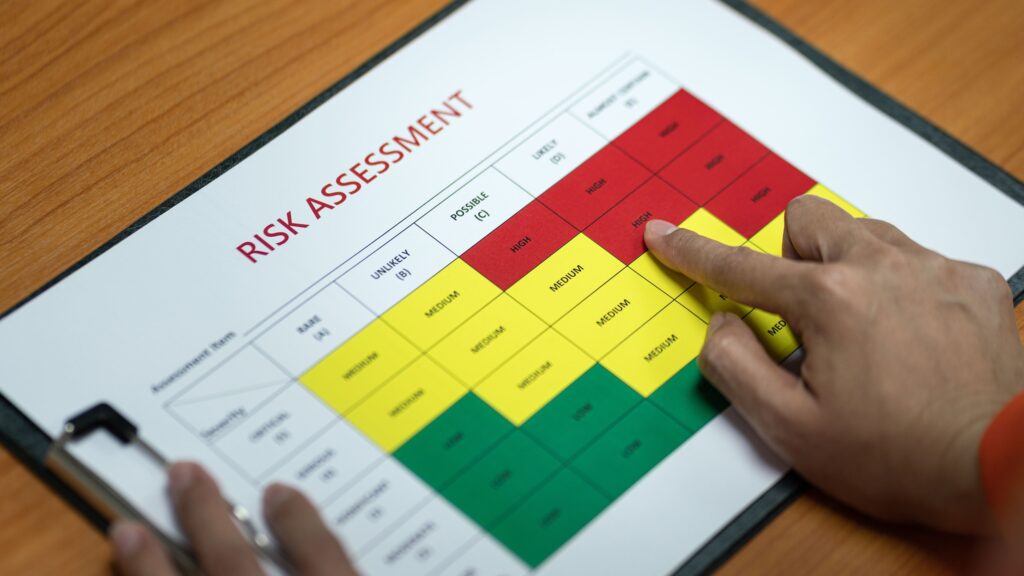
Graphical representation of risks that helps focus attention on events with high impact and high probability. - Root Cause Analysis
Identifying the true source of a potential problem, not just its symptoms - “What-If” Scenarios
Translating risks into specific scenarios: “What happens if delivery of a key device is delayed by 4 weeks?” and how the project responds. - Risk Reserves (Time and Budget)
Consciously planned buffers that protect the schedule and budget in case of specified events.
Risk Response Methods
At the project level, several typical response strategies are usually applied:
- Avoidance
Changing the scope, technology, or execution method in such a way that the given risk cannot occur at all. - Mitigation
Actions that reduce the probability or impact of the risk (e.g., additional testing, alternative suppliers, early resource reservations). - Transfer
Shifting the financial consequences or part of the responsibility to another party (e.g., warranties, insurance, contract clauses). - Acceptance
Consciously accepting the risk, but with a prepared contingency plan – often used for low-impact risks.
It is key that the risk response is designed in advance, rather than being improvised only in the event of a serious crisis.
Consequences of Poor Risk Management
Lack of thoughtful risk management in an industrial project does not mean risks are absent – it simply means no one is in control of them. Typical consequences include:
- Sudden, major schedule delays (e.g., lack of a critical component or decision).
- Significant budget overruns – unplanned additional work, expedited deliveries, emergency changes.
- Contractual disputes with contractors or suppliers – lack of agreements on responsibility in problem situations.
- Deterioration of relations with the end client – perception of chaos, lack of information, loss of trust.
- Safety risks – underestimated threats can lead to accidents, failures, or legal consequences.
In the extreme cases, lack of proper risk management leads to a situation where the project is formally “on track”, but in reality, it slips out of control – decisions are made ad hoc and the team is constantly firefighting.
Value for the Client – What do we gain from Professional Risk Management?
For an industrial client, well-organized risk management means:
- greater predictability—fewer “surprises”,
- better control over costs and timelines,
- enhanced security for the investment and reputation,
- ability to make decisions based on reliable information, not emotions.
This is precisely why one of the most important tasks for an experienced Project Manager and management team is systematic and transparent risk management – not to scare with threats, but to consciously control them.
Role of the Project Manager in Professional Risk Management
In industrial projects, risk is not the exception – it’s the standard. What distinguishes successful projects from problematic ones is conscious risk management, not avoidance.
For a professional Project Manager, risk management is not just tables developed with the team containing the current register of identified risks, analyses, reserves, and scenarios—it is part of his “natural DNA,” a daily mode of critical thinking and perceiving reality that enables him to “see” threats where no one else notices them and to “sense” potential dangers before anyone anticipates them.